Pokazywanie postów oznaczonych etykietą Memories of a Prisoner of War. Pokaż wszystkie posty

21 paź 2016

Powrót byłych jeńców do Szubina w 1971 r.


Podobnie jak podczas niedawnej wizyty członków Stowarzyszenia Rodzin Oflagu 64, potomków amerykańskich oficerów więzionych w nazistowskim obozie jenieckim w Szubinie, stanęli oni wspólnie z mieszkańcami Szubina do pamiątkowej fotografii, tak samo i 45 lat temu byli jeńcy Oflagu 64, postanowili powrócić do miejsca, który był ich domem w niewoli i również pamiątkowe zdjęcie zostało wykonane przed pomnikiem upamiętniającym obóz.

Pomysł pierwszej po wojnie podróży byłych jeńców Oflagu 64 do Szubina był dyskutowany w ich gronie już od kilku lat i ostatecznie w 27. stycznia 1971 r. roku komitet organizacyjny w osobach Johna F. Slacka, Charlesa G. Eberle’a oraz Franka W. Maxwella w drugim numerze gazetki „The Post Oflag 64 Item” ogłosili projekt o nazwie „Wielki Powrót do Szubina”: – “Zapamiętajcie daty 8-22 Maja 1971” – napisali – “To będzie podróż życia, więc nie przegapcie tego”.

Najważniejszym punktem ich dwutygodniowej podróży do Europy był zaledwie kilkugodzinny pobyt na terenie byłego obozu jenieckiego. Dla trzydziestu byłych jeńców możliwość zobaczenia ponownie tego miejsca, w którym niektórzy z nich spędzili będąc w niewoli ponad 18 miesięcy, była niewątpliwie niezapomnianym i sentymentalnym doświadczeniem.

Do Polski przylecieli lotem z Nowego Jorku do Warszawy przez Kopenhagę i w poniedziałek 10. maja wyruszyli przez Żelazową Wolę do Poznania. Program na 11. maja był krótki i treściwy: “Opuszczamy hotel po śniadaniu i udajemy się do Szubina – odwiedzamy teren byłego obozu, który jest teraz upamiętniony pomnikiem. W Bydgoszczy obiad z przedstawicielami lokalnych władz”.

W skład delegacji weszli następujący byli jeńcy wraz żonami: Jim i Peggy Bancker, Frank i Tracy Diggs, Dan i Millie Lewandowski, Don i Cassie Waful, Charley i Emma Eberle, Brooks i Mae Kleber, Ed i Elizabeth Batte, Ray i Eleanor Klinkenborg, Wright i Ellen Bryan, Lew i Janet Lowe, Gardner i Gert Simes, Joe i Sylvia Friedman, Bob i Gladys Thompson, Col i Mrs. Schaefer, Larry i Ash Phelan, Roy i Helen Chappell, Frank i Kay Maxwell, John i Mary Slack, Roy i Leilabeth Ihrie, Pete i Jane Graffagnino, Jim i Anne Fraser, Mae Goodlett, Erna Berzins, Amon Carter, Jack Rathbone, Irv Yarock, Len Vaden, Carl Hunsinger, Len Feldman, Ed Moschel, Tony Lumpkin, Bill Bingham oraz Emmet Shaughnessy.

Byli jeńcy Oflagu 64 odwiedzający Szubin (rozpoznani przez Billa Sharpe'a): 1. Amon Carter, 2. Irv Yarock, 3. Leroy Ihrie, 4. Jim Bancker, 5. Jim Fraser, 6. Colonel Schaffer, 7. Peter Graffagnino, 8. Don Waful, 9. Roy Chappell, 10. ???, 11. Len Feldman, 12. ???, 13. Joe Friedman, 14. Frank Maxwell, 15. ???, 16.   ???, 17. Edward Batte, 18. John Slack, 19. Tony Lumpkin, 20. Gardner Simes?, 21. Ed Moschel, 22. Larry Phelan, 23. Frank Diggs, 24. Ray Klinkenborg, 25. Charlie Eberle, 26. Bob Thompson.

Pośród osób odwiedzających Szubin był także Bryan Wright, były dziennikarz The Atlanta Journal i korespondent wojenny NBC, który 6. czerwca 1944 roku przeprowadził pierwszą relację z Lądowania w Normandii, a po dostaniu się do niewoli 12. września 1944 roku również trafił do Oflagu 64 w Szubinie, gdzie pozostał aż do „wyzwolenia” obozu przez Armię Czerwoną w 21. stycznia 1945 r.

Po powrocie tak zrelacjonował pobyt w Szubinie: “Gdy nasz autobus zbliżał się do Szubina, jeńcy, którzy zostali ewakuowani marszem w styczniu 1945 r., zaczęli dostrzegać charakterystyczne obiekty przy drodze, które zapamiętali. Gdy dotarliśmy w końcu do bram szkoły, w której murach w czasie wojny mieścił się obóz, każdy wziął głęboki oddech i ruszył w kierunku miejsc, które zapamiętał najlepiej. Tymczasowe baraki, wysokie ogrodzenie z drutu kolczastego i wieżyczki strażnicze dawno zniknęły, ale budynki, które kiedyś stanowiły główną część Oflagu 64 (Biały Dom, szpital, kaplica, dom komendanta) wyglądały praktycznie tak, jak w chwili, kiedy widzieli je po raz ostatni, z wyjątkiem wiosennej zieleni zamiast głębokiego śniegu. Większość z nas błyskawicznie zlokalizowała i pokazała swoim żonom miejsca, w których byliśmy zakwaterowani. To było najbardziej wzruszające z moich doświadczeń, ale były też inne. Nasi przedstawiciele złożyli wieniec pod pomnikiem wzniesionym w pobliżu byłej głównej bramy obozu przez Polaków dla upamiętnienia ich oporu przeciwko hitlerowcom, jak również dla upamiętnienia, że w miejscu tym w czasie II wojny światowej znajdował się obóz jeniecki.

Charlie Eberle, John Slack oraz Frank Maxwell składają wieniec z czerwonych róż od pomnikiem upamiętniającym obóz.

Dziennikarz Polskiego Radia, Ryszard Jankowski, zrelacjonował przebieg wizyty gości z USA w radiowym reportażu: “Goście udają teraz przed obelisk upamiętniający to miejsce męczeństwa postawiony w hołdzie dla ofiar II wojny światowej. Po złożeniu wieńca z żywych kwiatów u stóp obelisku wręczyli przedstawicielowi miejscowego społeczeństwa pamiątkowa plakietkę metalową z wyrytymi na niej wyrazami wdzięczności dla Polaków, którzy w czasie wielkiej próby złożyli niejeden dowód serdeczniej troski o losy uwięzionych aliantów”.

Słowa podzięki za otrzymany dar wygłasza w imieniu społeczeństwa dyrektor obecnego Zakładu Wychowawczego pan Alfons Jachalski: “W imieniu wszystkich obywateli miasta Szubina chciałbym serdecznie podziękować za miły upominek. równocześnie chciałbym podkreślić, że wysoko cenimy tych wszystkich, którzy zawsze pamiętają o tej tragedii narodowej, która spadła na nasz kraj i inne narody. Jesteśmy zawsze przyjaciółmi z tymi wszystkimi, którzy w walce przeciwko faszyzmowi stają w jednym szeregu. Po powrocie do waszego kraju, chciałbym, abyście waszym młodszym pokoleniom przekazali również pozdrowienia od narodu polskiego i aby oni podobnie jak my zawsze walczyli o pokój, który oby panował na całym świecie”.

Odwiedzający teren byłego obozu na tle byłego obozowego szpitala, od lewej: Len Vaden, Bob Thompson, Ed Banker; na drugim planie także: Ed Moschel, Billy Bingham, ???, Dr Graffagnino, Leroy Ihrie i Stacy Diggs.

Również w depeszy Associated Press publikowanej w Stanach Zjednoczonych w wielu dziennikach 12. maja 1971 r. opisano najświeższe wrażenia byłych oficerów odwiedzających obóz jeniecki:

SZUBIN, Polska (AP) – ‘Co u diabła zrobili z moją sypialnią?’, ‘Cmentarz zniknął’, ‘Nie zostało praktycznie wcale kolczastego drutu’. To typowe komentarze słyszane tu w ubiegły wtorek od grupy 30 byłych Amerykańskich jeńców odwiedzających po latach nazistowski obóz jeniecki. Oficerowie Armii Stanów Zjednoczonych wraz z żonami odbyli sentymentalną podróż, żeby zobaczyć miejsce, w którym spędzili ostatnie lata II wojny światowej. Rozświetlony jasnym wiosennym słońcem i przyjaznymi uśmiechami mieszkańców miasteczka którzy zgromadzili się wokół nich, Oflag 64 zmienił się zbytnio odkąd byli tu poprzednio. Obóz jeniecki, w którym przebywało ponad 1500 Amerykańskich jeńców wojennych jest obecnie Zakładem Wychowawczym  dla chłopców. (…).

Dwupiętrowy budynek pomalowany na kremowo, niegdyś główne koszary w obozie, obecnie mieści internat dla chłopców. Amerykanie zapamiętali zimne wilgotne pokoje ze ścianami w kolorze błota. Kiedy przechadzali się starymi korytarzami wielu z nich otwierało drzwi pokojów, w których niegdyś mieszkali. Nie zobaczyli w nich już jednak drewnianych pryczy, tylko schludne rzędy łóżek zasłanych kocami w typowo chłopięcych kolorach. ‘Co u diabła stało się z moją sypialnią?’ – huknął Larry Phelan – ‘Po środku pokoju stał duży metalowy piec, którego już nie ma. Dzięki niemu nie marzliśmy podczas mroźnych zimowych nocy’.

Podobne głosy można było usłyszeć, gdy odwiedzali obozową mesę, teraz również używaną przez wychowanków szkoły jako jadalnia. ‘Nie było tu świeżych białych obrusów na stołach ani jasnych ścian’ – wspominał Amon Carter – ‘Mieliśmy tylko drewniane ławy i miejsce to było zwyczajnie brudne’.

John Slack ogląda zorganizowaną w Zakładzie Wychowawczym wystawę, na której zebrano pamiątki z czasów wojny.

Również dziennikarz Polskiego Radia rozmawiał z Amonem Carterem:

Reporter: ‘Oczywiście nie jest to Pański pierwszy pobyt w tutaj, to jak mniemam drugi raz?’
Amon Carter, Jr.: ‘Nie, to znaczy… tak, Byłem tu przez 20 miesięcy w 1944 i 1945 r. Zyskaliśmy wielu przyjaciół pośród lokalnej ludności, którzy pomimo, że często doświadczali gorszych warunków, starali się uczynić nasze życie w obozie bardziej znośnym. Próbowali nam pomagać i zawsze dobrze żyliśmy z Polakami. Jest wielu dobrych Polaków w Ameryce i dlatego chcieliśmy wrócić tu, by móc znów spotkać się z naszymi polskimi przyjaciółmi tutaj. Jest nas tutaj razem pięćdziesiąt osób i przyjechaliśmy tu bezpośrednio z Poznania. Trzydziestu z nas to byli jeńcy i wielu z nas przybyło tutaj ze swoimi żonami. Obóz się zmienił i Szubin jest jakby większy. Mieszka tu więcej ludzi.

Reporter: 'Zapewne zamierzacie zobaczyć miasto?'
Amon Carter, Jr.: O tak, z pewnością! Kopaliśmy też tunel, którym chcieliśmy uciec, ale się zawalił. To było tam, tam gdzie jest ten nowy budynek. Tutaj był szpital, a ten budynek nazywaliśmy Weissenhaus (Białym Domem), jak ten, w którym mieszka nasz Prezydent w Waszyngtonie. Tam mieliśmy kaplicę, a za nią był cmentarz. Tu mieściła się kuchnia, gdzie wydawano nam posiłki. Nie dostawaliśmy zbyt wiele, ale to właśnie tam były wydawane. A to jest moja przyjaciółka ze stacji kolejowej. Widywałem ją dwa razy w tygodniu i naprawdę wiele pomogła nam wszystkim Amerykanom.’

W tym momencie rozmowy Carter przedstawia kobietę z Szubina, która pracowała (mieszkała) na stacji kolejowej. Choć w reportażu nie pada jej nazwisko, to wiadomo, że była to Eugenia Grecka.

Reporter: ‘Czy pani jest stąd, proszę pani?’
Eugenia Grecka: ‘Ja jestem stąd’.

Reporter: ‘Pan Carter wspomina, że Pani jest jedną z tych osób, które niosły pomoc jeńcom. W jakich warunkach niosła Pani tą pomoc? Czy to było powiązane z jakimiś niebezpieczeństwami?
Eugenia Grecka: ‘Wszystko cokolwiek się robiło, było zawsze powiązane z niebezpieczeństwami, ale o tym się wówczas nie myślało. Myślało się tylko, aby mieć jakieś powiązanie psychologiczne raczej, które by oddziaływało jakoś na psychikę naszych przyjaciół, aby im było z nami dobrze, a nam z nimi też było dobrze dosłownie. Cieszyliśmy się, kiedy mogliśmy im podać jakąś wiadomość, np.: o postępach w kierunku ukończenia wojny. Czy dopomóc im w wydostaniu się na wolność’. 

Amon Carter, Jr. rozmawia z Eugenią Grecką, z którą zaprzyjaźnił się, kiedy był jeńcem w Oflagu 64.

Eugenia Grecka przekazywała Carterowi informacje o stanie wojny usłyszane przez radio BBC. Eugenia zapisywała je i zostawiała w formie grypsów w jednym z koszy na śmieci przy dworcu. Carter odbierał je za każdym razem, kiedy przychodził tam wraz z niemieckim strażnikiem odebrać paczki z Czerwonego Krzyża. Poza dostarczaniem bieżących informacji o wojnie Grecka także przekazywała jeńcom noże i widelce, których używali jako narzędzi do kopania tunelu: ‘Dawałam je elektrykom, którzy mieli przepustkę do obozu i często tam bywali’ – powiedziała. Carter i Grecka zapamiętali jedną sytuację, kiedy to niemiecki strażnik znalazł pozostawioną przez nią w koszu wiadomość. ‘Kiedy ja przeczytał, powiedział, że mógłby dostać awans, gdyby na nią doniósł.’ – powiedziała Grecka – ‘A gdy odpowiedziałam mu, no dalej idź!’ – odparł – ‘Nie martw się, nie będę taką świnią’. Carter dodał – ‘Po prostu wykonywał swoją pracę. Dałem mu kilka papierosów, żeby milczał. Trzeba było umieć się i z nimi dogadywać.’

Teren byłego obozu jenieckiego Oflag 64, 1971 – budynek szkoły, który dla jenców był szpitalem.

Ciąg dalszy rozmowy z Amonem Carterem Jr.:

Reporter: ‘Pan Carter wspomniał już o słynnej ucieczce tunelem, który jeńcy tu wykopali. Czy pamięta Pan dokładnie, w którym miejscu się znajdował?
’Carter:  ‘Był w tamtym kierunku, ale tych baraków już nie ma. Te, w których mieszkałem zostały rozebrane. Był też inny tunel wykony przez Brytyjczyków, ale inni koledzy w autobusie będą wiedzieć lepiej, gdzie dokładnie się znajdował. Ja nie brałem udziału w kopaniu. Koledzy kopali, przez niemal rok. Mieliśmy spory problem z wykopaną ziemią. Składowaliśmy ją na poddaszu. Rozsypywaliśmy ją na terenie obozu. Nie ukończyliśmy go nigdy, ponieważ w innym z obozów hitlerowcy zamordowali 50 oficerów lotnictwa. Rozstrzelali ich po ucieczce tunelem [Wielka ucieczka ze Stalagu Luft III w Żaganiu]. Wiedzieliśmy jednak, że koniec wojny się zbliża i że wygrywamy. W związku z tym  bezpieczniej było zostać w obozie. Tylko jeden spośród nas faktycznie uciekł z obozu. Także pochodzi z Teksasu. Nazywa się Chappell i też jest w autobusie, ale nie uciekł zbyt daleko. Ledwo wydostał się z obozu, a oni zaraz spuścili za nim psy.’

Reporter: ‘Co Pan czuje stojąc w miejscu, w którym był Pan więziony podczas wojny?’
Carter: ‘Wszystko, co złe, już zdążyłem zapomnieć. Myślę, że czas leczy rany. Pamiętam owszem, że było ciężko, ale starałem się pielęgnować tylko dobre wspomnienia. Poza tym minęło już 27 lat, więc wiele szczegółów zdążyłem zapomnieć, ale Szubin i mieszkający tu ludzie na zawsze pozostaną bliscy memu sercu. Jestem zaskoczony, że Szubin ma o wiele więcej mieszkańców, niż wtedy, gdy tu byłem. Myślę, że Szubin miał wtedy ok. 4 albo 5 tys. Mieszkańców. A ile ma w tej chwili?’

Reporter: ‘Sześć i pół tysiąca.’
Carter: ‘A… czyli faktycznie przybyło.’

Reporter: ‘I rozbudował się jak widać.’
Carter: ‘Musi się tu dobrze mieszkać.’

Reporter: ‘Przed wojną Szubin miał tylko trzy i pół tysiąca mieszkańców, więc faktycznie liczba ta się podwoiła.’ 
Carter: ‘Tam była kwatera SS, baraki dla Gestapo, “Barracken” i Oberst [pułkownik], Schneider, niemiecki komendant mieszkał tam.’

Reporter: ‘A gdzie Pan mieszkał?’ 
Carter: ‘Mieszkałem w tym budynku [Biały Dom] a potem w jednym w baraków tam dalej. Już go nie ma. Każdy z nas trzydziestu ma swoją własną historię do opowiedzenia.’

Teren byłego obozu jenieckiego Oflag 64, 1971 – tzw. Biały Dom oraz jednopiętrowy budynek, w którym mieściła się obozowa poczta i szkoła.

Po powrocie do domu wielu spośród byłych jeńców dzieliło się z innymi swoimi wrażeniami ze wspólnej podróży:

“To zdecydowanie był najlepszy czas w moim życiu. Sensacyjna, fantastyczna, piękna, niewiarygodna i niezapomniana podróż. Brakuje słów, żeby to wyrazić. Nie da się tego przebić. Oczywiście, najważniejszy był moment powrotu do Oflagu 64 w Szubinie.”

“Zajęło chwilę zanim ochłonęliśmy po przyjeździe na miejsce. Oczekiwaliśmy, że wiele się zmieniło, a okazało się, że wiele wyglądało tak samo. Zniknęły owszem wieżyczki strażnicze i drut kolczasty. Także Mały Teatr, magazyn konserw, barak dla Rosjan I wszystkie drewniane baraki. Wszystkie pozostałem murowane budynki wciąż stoją, ale wiele zmieniło się w środku. Dla przykład pokój nr 2 w Białym Domu został podzielony na trze pokoje. Jedyny drewniany budynek, który pozostał, to ten na przeciwko wejścia do Białego Domy, gdzie znajdowała się pracownia krawiecka i warsztat szewski. Jedna rzecz nas tylko zawiodła. Władze nie pozwoliły nam wejśc do kaplicy, która wciąż stoi za domem niemieckiego komendanta obozu. Powiedzieli, że nie mają kluczy. Do wszystkich innych budynków nas wpuszczono.”
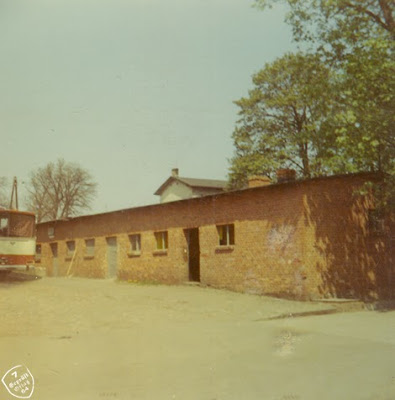
Grounds of the former POW camp, 1971 – public latrine and the chapel.

Frank Diggs napisał: “Wprost trudno uwierzyć, co znaczy powrócić do Oflagu 64, zwłaszcza po 26 latach. Po pierwsze przez ogromną różnicę pomiędzy tym dniem, kiedy opuściliśmy obóz podczas śnieżycy słysząc w oddali strzały radzieckiej artylerii, a pięknym wiosennym dniem kiedy przyjechaliśmy powrotem ze wszelkim komfortem do tego samego obozu, w którego obrębie teraz mieści się szkoła dla chłopców i panuje zupełnie inna atmosfera. Biały Dom wciąż tam jest, nie zmieniony z zewnątrz. Jest także budynek obozowego szpitala, wiele baraków, ale już bez ogrodzenia z drutu kolczastego. Zobaczyć to miejsce wraz żoną jak również starych znajomych, było wręcz nostalgicznym przeżyciem.”

Gardner Simes: “Pobyt w Szubinie był dla mnie smutny i wzruszający. Atmosfera niewiele się zmieniła, pomimo braku kolczastego drutu.”

Jim Bancker: “Ponowne odwiedziny Szubina było największa atrakcją. Zobaczyć ponownie Biały Dom i wciąż tam stojące cztery baraki było fascynującym przeżyciem dla mnie i mojej żony. Zobaczyła na własne oczy to, o czym tyle jej opowiadałem.”

Tony Lumpkin: “Jedną z największych przyjemności był powrót do Szubina i możliwość zobaczenia jak niewiele nasz obóz się zmienił, możliwość zobaczenia jeszcze raz miejsca, gdzie przyszło nam spędzić wiele długich dni w przeszłości.”

Don Waful: “Te piętnaście miesięcy, które spędziłem w Oflagu 64 we wszystkich wymiarach, emocjonalnie, materialnie i duchowo  ukształtowała mnie jako człowieka na całe życie. Powrót do tego miejsca i możliwość współdzielenia tych chwil z żoną i z wszystkimi razem, było wzruszającym doświadczeniem.”


Fragment filmu nakręconego podczas wizyty w Szubinie byłych jeńców Oflagu 64 (11 maja 1971 r.).


Podziękowania:

Serdecznie dziękuję Marlene Thompson McAllister, Nancy Thompson Wyatt oraz Taylor McAllister, córkom i wnuczce porucznika Roberta Thompsona, za podzielenie się zdjęciami oraz filmem dokumentalnym z podróży byłych jeńców do Szubina w 1971 r.

Źródła:
© Mariusz Winiecki
Copyright © for the Polish translation by Mariusz Winiecki

19 paź 2016

The Return-To-Szubin Reunion 1971


Very recently visiting members of the Oflag 64 Association, descendants of US Army officers who were held POW, gathered together with residents of Szubin in the front of the memorial to take a commemorative group picture. Forty-five years earlier their fathers, former prisoners of war at Oflag 64, took the opportunity to revisit Szubin for a commemorative group photograph as well.

Their first reunion in Szubin after the war was planned and discussed for several years and finally, on January 27th, 1971 the Reunion Committee consisting of John F. Slack, Charles G. Eberle and Frank W. Maxwell in the 2nd special edition of the Post Oflag 64 Item announced the Return-to-Szubin Reunion – “Remember the dates May 8-22, 1971” – they wrote – “It’s truly going to be the trip of a life time – so don’t miss that”.

During the two week-long journey to Europe, the highlight was just a few hours visit on the grounds of the former POW camp in which some of them stayed captive for more than 18 months. For the thirty former prisoners, it was an unforgettable exercise in nostalgia to see the scene of their captivity once again.

They arrived in Poland on a flight from New York to Warsaw via Copenhagen, and on Monday May 10th via Żalazowa Wola (birthplace of Chopin) they traveled to Poznan. The itinerary for Tuesday, May 11th was concise: “Leave the hotel after breakfast for excursion to Szubin – visit to former WWII campsite now marked by memorial. Lunch to be held in Bydgoszcz with local dignitaries”.

The group consisted of: Jim and Peggy Bancker, Frank and Tracy Diggs, Dan and Millie Lewandowski, Don and Cassie Waful, Charley and Emma Eberle, Brooks and Mae Kleber, Ed and ElizabethBatte, Ray and Eleanor Klinkenborg, Wright and Ellen Bryan, Lew and Janet Lowe, Gardner and Gert Simes, Joe and Sylvia Friedman, Bob and Gladys Thompson, Col and Mrs. Schaefer, Larry and Ash Phelan, Roy and Helen Chappell, Frank and Kay Maxwell, John and Mary Slack, Roy and Leilabeth Ihrie, Pete and Jane Graffagnino, Jim and Anne Fraser, Mae Goodlett, Erna Berzins, Amon Carter, Jack Rathbone, Irv Yarock, Len Vaden, Carl Hunsinger, Len Feldman, Ed Moschel, Tony Lumpkin, Bill Bingham and Emmet Shaughnessy.

POWs in picture as identified by Bill Sharpe: 1. Amon Carter, 2. Irv Yarock, 3. Leroy Ihrie, 4. Jim Bancker, 5. Jim Fraser, 6. Colonel Schaffer, 7. Peter Graffagnino, 8. Don Waful, 9. Roy Chappell, 10. ???, 11. Len Feldman, 12. ???, 13. Joe Friedman, 14. Frank Maxwell, 15. ???, 16.   ???, 17. Edward Batte, 18. John Slack, 19. Tony Lumpkin, 20. Gardner Simes?, 21. Ed Moschel, 22. Larry Phelan, 23. Frank Diggs, 24. Ray Klinkenborg, 25. Charlie Eberle, 26. Bob Thompson.

Among the (re)visiting group was Wright Bryan, the Ex-Atlanta Journal and NBC War Correspondent, who on June 6th, 1944 broadcasted the first report of the D-Day invasion after flying over Normandy with paratroopers, and after being captured by the German army on September 12th, 1944 became prisoner of war at Oflag 64 in Szubin Poland until “liberated” by the Russian army on January 21st, 1945.

After returning home he wrote: “As our bus approached Szubin, Kriegies who had marched out in January, 1945 began to sight landmarks they remembered. When we stopped at the gate of the school which had been our camp, everyone drew a long breath and headed towards spots they remembered best. Temporary barracks, high fences, barbed wire and look-out towers were gone, but permanent buildings which formed the nucleus of Oflag 64 (The White House, the hospital, the small chapel, The German commandant’s house) looked just as they had, except that springtime green instead of winter snow surrounded them. Most of us located quickly and showed our wives the very places we were once quartered. This was the most moving of my experiences, but others were numerous. Our committee’s placing a wreath on the monument erected by the Poles at the main gate to commemorate their resistance to Germans and the wartime use of these grounds, included an inscription honoring Americans who had been there”.

Charlie Eberle, John Slack and Frank Maxwell laying a large wreath of red roses at the village war memorial just outside the camp.

The Polish Radio reporter, Ryszard Jankowski, reported on the ceremony in his radio coverage: “The guests are coming to the obelisk, commemorating this place of martyrdom, which was erected as a tribute to the victims of WWII. After laying a wreath at the monument, they presented to the representative of the local community a commemorative plaque with an etched inscription as a token of gratitude to the Poles, who during very difficult times more than once showed their concern for the Allies imprisoned here”. It read: “Presented to our friends, the fine people of Szubin, Poland, to commemorate the return of the American prisoners of war”.

Words of thanks for the gift on behalf of the Szubin society were delivered by the Director of the Reform School, Mr. Alfons Jachalski: “On behalf of all citizens of the city of Szubin I’d like to warmly thank you for this kind gift. In the same manner, I would like to emphasize, that we always think highly about all those who always remember the tragedy that has befallen our country and other nations. We are always friends of those who stand by one another to fight against fascism. When you go back home I’d like to ask you to convey to your younger generations kind regards from the Polish nation. I hope they also will always fight for peace, in the same way as we do. So let there be peace for the whole world”.

Visitors in front of the hospital at Oflag 64, from left: Len Vaden, Bob Thompson, Ed Banker, then Ed Moschel then Billy Bingham, then ???, then Dr Graffagnino, then Leroy Ihrie, then Stacy Diggs.

The Associated Press article reporting the fresh impressions of the revisit was printed on May 12th, 1971 and later reprinted throughout the entire United States:

SZUBIN, Poland (AP) – ‘What the hell they done to my bedroom?’, ‘The cemetery has disappeared’, ‘Hardly any barbed wire left at all’. There were typical comments from 30 Americans who revisited their old Nazi Prison camp here Tuesday. All of them former Army officers, they journeyed with their wives from US to look at the place where they sat out the last years of World War II. With bright sunshine and friendly smiles from curious Polish villagers who gathered around them, Oflag 64 had changed a little since the Americans were last here. The camp, which housed about 1500 American war prisoners, is now a reform school for young boys. (…).

A five story cream painted building, which was the camp’s main blockhouse, is now used as bed lodgings for the young boys. The Americans remembered cold damp rooms, and mud-colored walls. As they walked down the old corridors, many of the ex-officers opened up the doors which used to be their rooms. There were no wooden bunks anymore, just neat rows of beds with gay-colored blankets. ‘What the hell they done to my bedroom?’ – boomed Larry Phelan – ‘There used to be a giant metal stove in the center and now it’s gone. It sure kept us warm on those freezing Polish winter nights’.

The story was the same in the mess hall, still used as a dining room by the school institute.‘There were no fresh linen table cloths and bright walls when we were here’ – recalled Amon Carter – ‘We just had wooden benches and the place was plain dirty’.

John Slack in the museum at Oflag 64 There was one room set aside as a museum and there were several military articles on exhibit.

Also the Polish Radio reporter talked to Amon Carter:

Reporter: ‘Of course you are not here for the first time; this is the second visit I hope’.
Amon Carter, Jr.: ‘No, I was….Yes, I was here for 20 months in 1944 and 1945 and we made many friends with our Polish friends and they were living under bad conditions but they tried making our lives more happy here in the camp.  They tried helping us and we’ve always liked the Polish people.  We have many good Polish people in America and we wanted to come back and say hello to our Polish friends.  There are 50 that are coming from Poznan.  There are 50 more.  There are 30 prisoners and some of them have their wives with them.  But the camp has changed and Szubin has many more people.  Szubin is growing’.

Reporter: ‘Would you like to have a look’?
Amon Carter, Jr.: ‘Oh, I will.  We dug a tunnel to try escaping and it collapsed.  It was up there.  That is a new building.  This was the hospital.  This was the, we called this the Weissenhaus (the White House), like where our President lives in Washington.  And we had a church and a cemetery over there.  That was the kitchen where we got our food.  We didn’t get very much, but when we got it, that’s where we got it.  And this was my friend at the railroad station.  I saw her twice a week and she was very helpful to all the Americans’.

During the interview, Mr. Carter introduced a lady from Szubin who worked at the Railroad Station and was very helpful to all the Americans. The lady introduced by Mr. Carter, was Eugenia Grecka.

Reporter: ‘Are you from here, ma'am?’
Eugenia Grecka: ‘Yes, and I still live here’.

Reporter: ‘As Mr. Carter has mentioned you were one of the few people, local residents of Szubin, who used to help them. What kind of help was it and were you in any danger because of it?’
Eugenia Grecka: ‘Everything we used to do for the POWs was at the risk of being shot, but we didn’t think about it at the time. We tried to support them emotionally. We tried in some way to be in touch with them to show that we sympathized with our American friends, to have an influence on their morale, to make them feel not so lonely here and in this way not to lose their spirit. We were happy when we were able to send them any message, for example about any progress in the direction of the end of the war. We tried to be helpful in case of escape attempts, because several times we were the witnesses of their unsuccessful efforts to get out of the barbed wire compound’.

Amon Carter, Jr. talking to Eugenia Grecka who befriended him while he was at Oflag 64 as a POW.

Eugenia Grecka gave Carter radio war news, which she got from BBC. Eugenia would write the news down and leave it in one of the station’s waste baskets. Carter picked it up every time he went down with his German guards to collect Red Cross parcels. Besides giving the Americans up-to-date war newsGrecka also passed them knives and forks to use as tunneling appliances ‘I would give them to Polish electricians who were allowed  every so often inside the camp’ – she said. Carter and Grecka remembered one moment when a German guard found a message she left in a station basket. ‘The German opened it and after reading through it he could be promoted for reporting me’– said Mrs. Grecka – ‘When I told him to go ahead he replied. Don’t worry I won’t be such a swine’. Said Carter – ‘He was just doing his job. I gave him few cigarettes. You got to be a good horse trader’.

Grounds of the former POW camp, 1971 – the Reform School, for POWs it was the camp hospital.

The continuation of the Interview with Amon Carter Jr.:

Reporter: ‘Mr. Carter has already mentioned the famous flight (famous escape) by means of the sap (tunnel), which the POWs dug here. Do you remember the exact place where you dug (the tunnel)?’
Carter: ‘It was over in that direction, but the barracks are all gone. Where we lived is destroyed. And there was another tunnel in here that the British built, but the other boys on the bus will know where the tunnel is. I did not dig it. My friends dug it, I think for one year. And the big problem was where to put the dirt. We had dirt up in the roof. We put it on the ground. But we never finished the tunnel because in other lagers, the Germans murdered about 50 air force officers. They shot them when they came out of the tunnel, so we knew we were winning the war [referring to The Great Escape from Stalag Luft III in Sagan]. And it was best to stay in the camp. We only had one man who ever escaped. You say flight, we say escaped, from the camp and he is also from Teksasu [Texas]. And he is on the bus, Mr. Chappell, but he did not get very far. He got out of the camp and then they turned die Hunde or the dogs on him’.

Reporter: ‘What are your most personal impressions standing here in the very place where you were a prisoner during the war?’
Carter: ‘With my friends? I have forgotten all the bad things.  You know time heals many wounds.  And I just remember there were many bad things, but I remember the good things only and this was 27 years ago, so you forget a lot, but I still have a fond memory in my heart for Szubin and the people of Poland.  I’m surprised that Szubin has more people than when I was here.  I think Szubin had maybe four or five thousand people. What is the population of Szubin now?’

Reporter: ‘Six and a half thousand’.
Carter:‘Well, it has grown’.

Reporter: ‘Yes, rebuilt as you see’.
Carter: ‘It must be a good place to live’.

Reporter: ‘Before the war, there were only three and a half thousand people living here, so it has doubled’. 
Carter: ‘Over there was the SS, the barracks, the Gestapo “Barracken” and Oberst Schneider, the Deutsch Kommandant, he lived over there’.

Reporter: ‘And where did you live?’
Carter: ‘I lived in this house and then in a barracks up there.  It is gone now.  I’m just one person and we have 30 others and everyone has got a different story’.

Grounds of the former POW camp, 1971 – for POWs: The White House and one-story building.

After returning home the former POWs shared details of their impression with the others:

“It was the best of times. It was positively the best of times! It was sensational, fantastic, beautiful,unbelievable unforgettableThe return-To-Szubin reunion was the super superlatives ever spoken! The consensus, It could never be duplicated!“

“Of course, the highlight of the tour was returning to Oflag 64 at Szubin. It took a few minutes to become acclimated after we arrived. It seemed to be different, yet it seemed the same. The guard towers and the barbed wire are gone, The Little Theater, the Tin Store, The “Russian“ barracks and all other wooden barracks are down. All other brick buildings still stand, but there have been some interior changes. For example room two in the White House has been partitioned to make three rooms. The one wooden structure remaining is the one opposite the White House entrance where the tailor shop and shoe repair were set up.We experienced one disappointment at Szubin. The authorities would not let us into the Little Chapel, which still stands behind the house where the German Commandant lived. They claimed they didn’t have a key. Every other building was open for us“. 

Grounds of the former POW camp, 1971 – public latrine and the chapel.

Frank Diggs wrote: “You wouldn’t believe what it’s like to return to Oflag 64, first of all, after 26 years. I think it was primarily the contrast between that day we marched out through the barbed wire gate during a snow blizzard with the Russian artillery sounding in the background, and beautiful Spring day which we drove back, in great comfort,  to the same camp – now a boy’s school with sort of campus atmosphere. The White House was still there, unchanged outside. So was the hospital, the chapel, many of the barracks, but without the barbed wire. Seeing the place again with your wife and fellow alumni was downright nostalgic“.

Gardner Simes: “Szubin was sad and moving, The atmosphere hasn’t changed in spite of no barbed wire“.

Jim Bancker: “Revisiting Szubin was of course, the highlight, and seeing the White House and four of the barracks still standing was thrilling for me and my wife. She now has seen in person what I have talked about so much“.

Tony Lumpkin: “One of the real pleasures was the return to Szubin and to see how little the camp has changed and to be able to see and be in the actual area where so many long days had been sweated out in the past“.

Don Waful: “My fifteen months at Oflag 64 in all its dimensions – emotionally, materially, spiritually, were of lasting significance in my life. To return to the scene and to share it with my wife, whoshared it with me then altho’ remotely, has been a moving experience“.

Excerpt from the VHS tape of the trip found by Marlene McAllister (daughter of the late Kriegy Robert Thompson) after going through her father’s papers.

Acknowledgements:

My special thanks to Marlene Thompson McAllister, Nancy Thompson Wyatt and Taylor McAllister, daughters and granddaughter of 1st Lt Robert T. Thompson for providing photographs and the video footage for the article. Thanks also to Bill Sharpe for identifying the men in the picture.

Sources:
© Mariusz Winiecki

7 wrz 2016

Visit to Poland by Descendants of US Army Officers held POW in Oflag 64


I am the son of a prisoner of war who served two years two months and 10 days with the best of the best, his fellow prisoners. I am forever indebted to all of my brothers and sisters who have shared the same experience and grown up together. We are all bonded by the years our dads spent as the "guest of the Germans" (daddy would have referred to it that way) in beautiful Szubin, Poland. A land unto its own, for the people were so kind to Americans and so helpful to their survival. We are all truly grateful.

George Patton ‘Pat’ Waters, son of Lt. Col. John Knight Waters

On September 3rd members of the Oflag 64 Association, descendants of US Army officers who were held POW in the largest US ground force officers' prison camp in Europe arrived in Poland for a week’s visit. Although their primary goal was to visit the former camp site where their fathers were held prisoner, they wished to commemorate the sacrifice of Polish soldiers with a wreath-laying at the Tomb of the Unknown Soldier in Warsaw, as well as a second wreath-laying to honor the suffering of Polish civilians of all faiths and the various nationalities held POW in Szubin. They also held meetings regarding the creation of a Hall of Remembrance and a Language Lab at the former camp site. 

The first US Army officers brought to this camp were taken prisoner in February 1943, after the Battle of Sidi Bou Said, Tunisia and arrived in Szubin in June of 1943.  Among them were two officers who had been taken under duress to Katyń in May 1943. They were Lt. Colonel John H. Van Vliet, Jr. and Captain Donald B. Stewart, who upon their return to the oflag advised Washington D. C., via coded letters, of the truth about Katyń. 

Others included the future General John Waters, Lt. Craig Campbell (aide-de-camp to General Eisenhower) and Larry Allen, an Associated Press correspondent and winner of the 1942 Pulitzer Prize for his war reporting. Prisoners continued to arrive after D-Day and the camp reached some 1,500 men by January 1945. The camp was the site of what was planned to be the largest escape ever planned – which was scuttled by plans for Operation Overlord (D-Day).

Although some of the POWs arrived in Oflag 64 in June 1943 (Waters, Van Vliet, Stewart), others arrived later, and represented in the visiting group were descendants of both POW groups:
  • 2nd Lt George A. Cobb, taken prisoner on February 12, 1944 in Anzio Italy (at the Battle of the Factory);
  • 2nd Lt Reid F. Ellsworth, taken prisoner on January 24, 1944 in Italy, escaped from the January 1945 march and headed east through Poland, made it out through Odessa;
  • Lt Col Nathaniel R. Hoskot, taken prisoner on June 6, 1944, repatriated on compassionate exchange on January 7, 1945;
  • 1st Lt Robert T. Thompson, taken prisoner on September 22, 1944; on January 21, 1945 marched out of Szubin, reached Oflag XIII-B at Hammelburg on March 10, 1945;
  • Lt Col John K. Waters, who was the son-in-law of Gen. George S. Patton, and later was nominated general, taken prisoner on February 14, 1943 at Kasserine Pass, North Africa, on January 21, 1945 marched out of Szubin, reached Oflag XIII-B at Hammelburg on March 10, 1945.

From left to right: 2nd Lt George A. Cobb, 2nd Lt Reid F. Ellsworth, Lt Col Nathaniel R. Hoskot, 
1st Lt Robert T. Thompson, Lt Col John K. Waters

The members of the group included Elodie Ellsworth Caldwell and Janet Ellsworth; Tom Cobb; Anne Hoskot Kreutzer and Tom Kreutzer; Marlene Thompson McAllister and Nancy Thompson Wyatt with Taylor McAllister; and George Patton “Pat” Waters. The group’s travel was coordinated by Krystyna Piórkowska, historical researcher and author of “English-speaking Witnesses to Katyn Recent Research”.

The group have also visited the Katyn Museum and Museum of the Uprising in Warsaw, as well as Częstochowa, Auschwitz, Wieliczka and the Wawel Royal Castle in Cracow. 

* * *

Their visit to Szubin began at the Railroad Station through which almost all POWs were brought by train. Red Cross parcels were regularly picked up by some of them from this Railroad Station as well. After that they met with the Director of the Regional Museum, Kamila Czechowska, and visited the Muzeum Ziemi Szubińskiej to view the exhibition about WWII times in Szubin County and the general history of POW camps in Szubin. From the Regional Museum the group took a walk to the Main Square of Szubin to take a group picture in front of the statue of the pelican wounding its breast to feed its chicks – the coat of arms of Szubin. By the way they also visited the buildings of the former printing house in which the camp newspaper "The Oflag 64 Item" was printed. They were welcomed by Marek Kapsa, the grandson of Józef Kapsa, who was the founder and primary owner of the print house where Willi Kricks printed ‘The Item’. Later, the group toured the Old Town of Szubin and visited the ruins of the knights' medieval castle from the XIV century, as well as the Church Of Saint Martin The Bishop founded at the same time. After that they went to the Szubin cemetery to see the place where POWs who died in POW camp, including Capt. Richard H. Torrence of Oflag 64, were buried during WWII. They also saw the place where the movie theater ‘Balten-Lichtspiele’ was, where POWs were allowed to attend for a short time, under guard, to see German movies.

Before the visitors finally reached the site of the former POW camp, they met with the President of the Council, Remigiusz Kasprzak, the Mayor of Szubin, Artur Michalak and Vice Mayor of Szubin, Krystyna Sichel, to discuss the city’s plans to create a Hall of Remembrance in one of the original remaining barracks.

After that the guests walked in the direction of the former camp to stop at the Flame Memorial for a  brief ceremony to commemorate the Polish civilians, and the Polish, French, and Commonwealth of Nations POWs, as well as the Americans who were held POW in the camp at various times. They laid a wreath at the memorial to honor their fathers and all POWs who were held there in the previous camps known as Stalag XXIB and Oflag XXIB.

Oflag 64 represents a very personal place in my life. My father, George Cobb, was captured on February 12, 1944 at Anzio Beach, Italy and was at Oflag 64 until the march from the camp in January 1945. He remained in the service, fought in Korea and retired as a major.  He died at the age of 49, I had just turned 16. Like most veterans, my father rarely spoke about his experience in the wars that he fought or the time he spent as a POW. The one time he did speak about any of his experiences was to express his appreciation for the kindnesses and help he received from the Polish citizens after his escape from the march in January 1945, and as he walked his way through the countryside. (…) we know that many Polish citizens put their own lives in jeopardy during the war as they assisted POWs with escapes and shared what little food they had.  We, as descendants of American POWs are very grateful for the sacrifices of your forefathers and would like to say thank you Poland, then and now, for your support and continued interest.

Excerpt from presentation by Tom Cobb

Their visit culminated with a tour of the remaining Camp Complex – the former camp hospital, the former Brig, the Chapel, the Commandant’s house, and most importantly the ‘White House’ where the senior officers were held. They then entered the MOAS (Home for At Risk Youth) where the majority of the barracks were previously located. Their host there was Wiesław Guziński, Director of MOAS. There they viewed the scale model of Oflag 64 built by the residents of MOAS under the supervision of their teachers, Tomasz Kmieć and Mieczysław Luchowski. The woods, located near the camp site where the Jewish Cemetery was before the war, were visited as well. At the Jewish cemetery the mass execution of Polish citizens of the pre-war County of Szubin occurred. These were Poles who were incarcerated in 1939 in the internment camp for civilians (Ilag, an abbreviation of the German word Internierungslager für Zivilpersonen) which was located in the same buildings which later became the POW camp. Afterwards they journeyed to the location of the Sierniki Farmhouse, where their fathers spent the first night after being marched out of the camp on January 21, 1945 and from where many of them escaped from the Germans. At the former POW camp site they were guided by Mariusz Winiecki, a local resident and historian of the Camp Complex. 

Another of the goals of the visit was to support the US Embassy’s plan to create a Language Lab, to be located at MOAS but also available to the local community. This is a furtherance of the Oflag’s educational program of schooling the POWs in various areas, including languages.  Involved in this project is Col Warren Barlow, Office Chief of the Office of Defense Cooperation U.S. of the US Embassy.

* * *

The history of the Oflag 64 Association dates back directly to post-war times. There was a core group of men, former POWs of Oflag 64, who organized and planned reunions for a number of years, with the first Oflag 64 reunion being held in 1946 in Newark, New Jersey just a year after the war ended. Originally they were held for the Kriegies and their wives and generally for the same purpose as they are held today. The men and their families became very close and formed lasting friendships. Not until 1986 were they held yearly. Previous to that there was a span of several years between them. As time has passed, reunions have also been attended by children of Kriegies and sometimes friends. Unfortunately, as the years have gone by most of the Kriegies have also passed away. Out of the original approximately 1,500 Kriegies who were in captivity at Oflag 64, there are about 50 Kriegies still living, each over 95 years of age.

When their reunions finally come to an end due to the passing of the Kriegies, association members will continue to honor them on their Oflag 64 Association website. They will continue producing a quarterly newsletter entitled The Post Oflag 64 Item, loosely patterned after the original camp newspaper, The Item, designed to keep everyone informed as it did in previous years. Currently it is mailed in hardcopy format to all living Kriegies and their spouses, or widows of deceased Kriegies, while other association members receive notice that a digital version has been posted electronically to the www.oflag64.us website.

Over time, because of reunions or other get togethers, members of the Oflag 64 Association have become like family.  Even though they’re spread across the entire United States, they have bonded with each other and continue to enjoy each other’s company at reunions and wherever they meet. Many have developed close relationships, just as their Kriegy fathers and grandfathers did in earlier times, and keep in touch with each other on a regular basis. They maintain an email list which helps keep them connected with news and information when it is provided by others.


Photos by Mieczysław Luchowski, Mariusz Winiecki

More photos at the website of:

Muzeum Ziemi Szubińskiej and szubin.pl

More Press Coverage:

TVP Bydgoszcz

Radio PIK

Gazeta Pomorska


© Mariusz Winiecki