Pokazywanie postów oznaczonych etykietą Rotenburg an der Fulda. Pokaż wszystkie posty

15 mar 2016

American POWs in Oflag IX A/Z at Rotenburg an der Fulda, Germany, Part 2

Part 1

During the short period when US Army POWs were held in this camp, the Senior American Officer in Oflag 9A/Z was Lt. Colonel John H. Van Vliet, Jr.  The following intriguing entry in the War Diary of John H. Glendinning was made on the day these POWs were transferred to Oflag 64 in Altburgund (Szubin): “We left Van Vliet and Chappell [1st Lt Roy J. Chappell Jr.] behind. Chappell had ‘milk shot’ fever and Van Vliet fell down stairs and has a possible ‘hip fracture’. I hope they make it.”

The reason for their ‘hospitalizations’ and why they stayed behind was that a large tunneling project had been organized by the British Officers right under German noses. Van Vliet and Chappell were included by the British in their escape plan, and worked on the escape tunnel together with a larger group. When the Americans learned that they would be moved to another camp prior to completion of the tunnel, it was decided that the two Americans who had been included in the project would remain behind. As Howard Holder wrote in his book: “It was necessary to adopt strenuous measures. One of them, Lt Col. John Van Vliet from Red Bank, New Jersey, was placed in the hospital as the result of a very convincing fall down some stairs in front of unimpeachable witnesses, and the other, Roy J. Chappell from Reffugio, Texas, took some medicine under doctor’s supervision which gave him a very realistic fever, and he was sent to hospital too.”

The fact is that the existence of the tunnel had been discovered by the Germans, who had planted a spy in the camp (as they so often did), who claimed to be an English officer transferred from the camp at Spangerberg (Oflag IXA/H). Although, at the beginning, he was regarded with distrust and for a long time was not allowed to learn the secret of the tunnel, he became agreeably helpful around the camp whenever possible, as recalls Holder, and this made him more acceptable, and which allowed him to fulfill his mission. Holder has written about the tunnel: “The construction of the tunnel at Rotenberg was so good that several German generals were invited to go down into it and see the electric lights and ventilating system.”

After the failure of the tunnel escape, Van Vliet and Chappell were sent to join the rest of the US POWs in Oflag 64.

There is also another recollection from Rotenburg, which can be found in Bradford’s memoirs and refers to the historic mission of the SAO and Capt. Donald Stewart, who were sent to the Katyn Massacre site as part of a group of English-speaking witnesses: “Col. Van Vliet and Capt. Don Stewart (17th Field) both West Pointers, were pulled from IX A/Z and hauled down to Katyn Forest in SE Poland [sic!] to forcibly view a mass grave of approximately 10,000 Polish officers and men executed by the Russians during their retreat from the Germans. This was not made common knowledge to us until after we arrived at Oflag 64. In fact I was convinced that this episode occurred while at 64 until I heard from Van Vliet’s own lips the straight of it at Las Vegas in 1984.”


After their return, coded messages, confirming Soviet culpability, were sent from Oflag 64 by Captain Donald B. Stewart and Lieutenant Colonel John H. Van Vliet Jr., in letters which were addressed to their families and were intercepted by US military intelligence.After the issuance of the Soviet Burdenko Report of January 1944, concerning the Katyn Massacre, coded letters querying the original statements were sent by Military Intelligence to Oflag 64, and they were responded to by Lt. Colonel Van Vliet and Captain Stewart where upon  they reaffirmed their position as to Soviet guilt. 

Although the other POWs in Oflag 64 were aware that Van Vliet and Stewart had been sent to Katyn (it was public information), they never discussed what they had seen nor what their opinion was upon their return to the Oflag.  This is confirmed by Colonel Van Vliet’s statement in his (recreated) report of 1950: “Throughout the rest of our time in prison camps Capt. Stewart and I refused to discuss our experiences concerning Katyn and never stated what opinion we had formed”.

On March 24th, 1944 in Oflag 64, both, Lt. Col. Van Vliet and Capt. Stewart, wrote and signed a document certifying the  relevant facts about their trip, except for one – any indication of the guilty party.

The highlights of this memo are that they were ordered from Oflag IX A/Z to Katyn over their protest and refused to sign a parole (i.e. confirming that they would not escape during the trip), that during the inspection which took place on May 13th 1943, the mass grave was shown to them and that German photographers took both still and moving pictures of the entire POW party.


Lt. Col. John H. Vliet and Capt. Donald B. Stewart certified in March 1944 that they were shown the Katyn Forest mass graves by their Nazi captors (US National Archives College Park).


This document was requested of them by the Puissance Protectrice – the Swiss Protecting Powers – who represented the interests of the POWs of all nations.  Prior to being taking from Oflag IX A/Z, Van Vliet and Stewart had both submitted written protests, not only to the Camp Commandant, but also had sent them to the Puissance Protectrice. They, in turn, informed the US State Department, which was the only US government agency contacted by the Swiss. The various delays meant that this protest, submitted in late April 1943 took almost a year to elicit a response and arrival of a query from the US State Department.

The very intricacy of the entire process – the officers recording a protest to the Swiss Protecting Powers, as well as the German authorities, refusing to collaborate with the Germans in any way, and then upon their return, ensuring that the US authorities were advised via coded letters that guilt for the largest single massacre of POWs in history, was the responsibilityof the Soviet Union, with follow up questions arriving at the camp at the same time that the query from the Puissance Protectrice arrived leads to a dizzying set of overlays.

Photograph scanned from Daily News, Tuesday, February 5, 1952 (Thanks to Cynthia Burgess, daughter of Kriegy Wilbur Sharpe).

Despite being repeatedly asked for their opinion, both Van Vliet and Stewart refused to discuss it in any way. Copies of some photographs of the visit of the English-speaking witnesses, made by the Germans (in violation of the Hague convention, which was why the photography was mentioned in the March 1944 document) during the POWs visit to Katyn,were given to them however, the Germans did not succeed in achieving their goal of having the POWs speak out on this visit, as no public statement was made by any of the POWs concerning their opinion on the Katyn incident. The two US Army officers did advise US Military Intelligence during their captivity and both testified to the US House Committee on the Katyn Massacre (Madden Committee) while the British POWs either made reports immediately upon their release or wrote about it in their memoirs (Gilder, Stevenson, Stroobant). What is still not known however, is whether the British Other Ranks made reports.

 Captain Donald B. Stewart (center) and South African Lt. Col. Frank P. Stevenson at Katyn, May 1943. Amtiches Material zum Massenmord von Katyn, Berlin, 1943, p. 297 (Hoover Institution Library).

Thus, the former site of Oflag 64 in Szubin is the place where the truth about the Katyn Massacre was not only kept for a period eighteen months, by Lt. Col. John H. Van Vliet, Jr. and Capt. Donald B. Stewart, but it is also the place from where, by means of coded letters they each transmitted the truth in the summer of 1943 and the spring of 1944 to the US and British governments (the two sides shared military intelligence) confirming Soviet guilt for the Katyn Massacre.

Articles about Lt. Colonel John H. Van Vliet Jr. and Captain Donald B. Stewart, their mission and testimonies, as well as about the other English-speaking Witnesses to Katyn can be read at “Researching Katyn – Coded English Letters” blog authored by Krystyna Piórkowska. Krystyna Piórkowska is the author of “English-speaking Witnesses to Katyn Recent Research” a bilingual book issued by The Katyn Museum, division of the Polish Army Museum.

Acknowledgement:

Preparation of this article would have not been possible without invaluable contribution from Krystyna Piórkowska. Thanks to the Stewart and Van Vliet families for their assistance. My thanks also to Lucy Lussenden, widow of Kriegy Don Lussenden, for helpfull discussion.

References:
  • “English-speaking Witnesses to Katyn Recent Research” by Krystyna Piórkowska, 2012.
  • “Escape to Russia” by Howard Randolph Holder, 1994; thanks to David Durgin for the photocopy of the book.
  • Transcript of War Log of 2nd Lt. John H. Glendinning available in “Sketches of lives of Kriegies in Oflag 64” (Thanks to Cynthia Burgess).
  • Memories of 1st Lt. O. L. “Brad” Bradford: "The Way It Was" available at www.oflag64.us.
© Mariusz Winiecki

3 lut 2016

Amerykańscy jeńcy w Oflagu IX A/Z w Rotenburgu nad Fuldą, Część 1


Zanim w Szubinie otwarto Oflag 64, część amerykańskich oficerów sił lądowych, którzy tu ostatecznie trafili, przebywała w Oflagu IX A/Z w Rotenburgu nad Fuldą. W tym czasie (marzec 1943) w obozie tym przebywało już 568 oficerów brytyjskich. Większość z nich była weteranami walk we Francji wziętymi do niewoli pod Dunkierką w 1940 roku, ale była też część uczestników innych kampanii takich jak: Grecja, Kreta, Dieppe, St. Nazaire czy walki w Afryce Północnej. Grupa Amerykanów dotarła do Rotenburga 15. marca 1943 roku. Był to raczej niewielki obóz, składający się z trzypiętrowego budynku z niewielkim dziedzińcem, w którym przed wojną mieściła się szkoła dla dziewcząt (Jakob-Grimm-Schule, założona w 1924, www.jgs-rof.de).

Szkoła imienia Jacoba Grimma w Rotenburgu nad Fuldą, w której w czasie II wojny światowej mieścił się niemiecki obóz jeniecki Oflag 9A/Z, zdjęcie pochodzi z: Manuscripts and Pictorial Collections of the Alexander Turnbull Library.

Podporucznik Howard Randolph Holder wspomina przybycie do obozu w swojej książce “Escape To Russia”:
“Nasz pierwszy posiłek w Rotenburgu był dość dobry. Była to wodnista zupa, kilka ziemniaków oraz dwa czy trzy plasterki czegoś w rodzaju kiełbasy. Część z tego to była krwawa kiszka (kaszanka), której nigdy nie nauczyłem się jeść, bez względu na to jak byłem głodny. (…). Wielu oficerów ogoliło się w po raz pierwszy w Oflagu IX A/Z. (…). Mieliśmy także po raz pierwszy możliwość doprowadzenia się do czystości. W piwnicy szkoły mieściła się wyłożona kafelkami łaźnia, w której codziennie mogliśmy korzystać z zimnych pryszniców. Ciepła kąpiel była możliwa raz tygodniowo i przebiegała według napiętego harmonogramu – na każdego jeńca przypadało 8 do 10 minut. (…). W Oflagu IX A/Z otrzymaliśmy też naszą pierwszą wypłatę (żołd, w myśl art. 23. Konwencji Genewskiej z 27 lipca 1929 roku) . (…). Pieniądze, które otrzymaliśmy nie były regularnymi niemieckimi markami, ale formą papierowego pieniądza zastępczego obowiązującego jedynie na terenie obozu. Banknoty wydrukowane w różnych kolorach na lichym papierze miały kilka nominałów. Były ładne, ale bezużyteczne.”


Oryginalne pieniądze obozowe (obowiązujące w niemieckich obozach jenieckich II wojny światowej) z archiwum podporucznika Seymoura R. Boltena; przywiezione do Szubina przez jego córkę, Susannę Bolten Connaughton, w ubiegłym roku, dzięki czemu można było je zeskanować.

Adnotacja na banknocie w tłumaczeniu z języka angielskiego zawartego w książce Howarda Randolpha Holdera:

“Pieniądz obozowy
Talon o nominale 1 [2, 5, 10, 50] Reischmarek
Bon ten jest obowiązującym środkiem płatniczym przeznaczonym wyłącznie dla jeńców wojennych, może być wydawany lub przyjmowany jedynie w specjalnie wyznaczonych sklepach znajdujących się na terenie obozów jenieckich lub obozów pracy.
Wymiany na [obowiązujący na terenie Rzeszy] prawny środek płatniczy można dokonać wyłącznie w kasie administracji obozowej. Naruszenie [powyższych zasad], naśladownictwo albo fałszowanie będzie karane.
Naczelnik Dowództwa Niemieckich Sił Zbrojnych.
Z rozkazu: [Podpis]”

Bardzo szybko amerykańscy oficerowie włączyli się w różne obozowe przedsięwzięcia. Jak można przeczytać we wspomnieniach Lu Wilcox’a [Kapitana Lumunda Wilcox’a]:  
“[Brytyjscy oficerowie w Oflagu IXA/Z] byli dla nas niezwykle mili i naturalnie chcieli wiedzieć od nas jak najwięcej o losach wojny oraz Anglii, ale dopóki nie wybadali każdego z nas z osobna, jak również nie przesłuchali innych na nasz temat, nie zdradzili nam nic o sobie, jak też o ich obozowym życiu. Dopiero kiedy przekonali się, że nie ma w naszej grupie sympatyków Niemców, stali się otwarci i udzielili nam pierwszej lekcji jak jako jeniec przetrwać w obozie. (…). Nauczyli nas jak w najlepiej urządzić sobie życie w obozie jenieckim. Jednym z ważnych aspektów [tego życia] była rozrywka oraz gry. Jeniec wojenny dysponuje nadmiarem wolnego czasu, który może spędzać użalając się nad swoim losem, ale może też zaangażować się w wartościowe przedsięwzięcia realizowane dla poprawy swojego własnego bytu albo mając trochę inwencji, może obmyślać jak na tysiące sposobów uprzykrzyć życie swoim oprawcom doprowadzając ich do granic frustracji, lecz nigdy tej granicy nie przekraczając.”

Fragment ze wspomnień porucznika O. L. “Brada” Bradforda:
“[Brytyjscy oficerowie w Oflag IXA/Z] przygotowywali rozrywkę sceniczną każdego tygodnia. Goddard [porucznik Kenneth H. Goddard*] i Rankin [podporucznik Robert Rankin*] grający na pożyczonych instrumentach, odpowiednio na perkusji i trąbce, szybko stworzyli zespół swingowy. Wyprodukowali także typowo amerykańską rewię, składająca się w większości z ludowych piosenek oraz radiowego humoru, co zostało bardzo dobrze przyjęte.”

*Oboje byli później więźniami w Oflagu 64.

Niektórzy spośród Amerykańskich oficerów zostali zaproszeni do produkcji teatralnej przygotowywanej przez oficerów brytyjskich. Major G.C. “Geoff” Steel, Anglik, produkował sztukę, w której przewidziane były role dla trzech Amerykanów. Według książki  “Escape To Russia”, gdy dowiedział się on, że Howard Holder (autor tejże książki) interesuje się sztuką dramatyczna, zaprosił go na próbę. Trójki dopełnili podporucznik John L. Cramer, Jr. z North Braddock, Pennsylvania oraz Kapitan Wilfred “Bill” F. Farrell z Wilmington, Delaware, oboje także późniejsi jeńcy w Oflagu 64.

“Spektakl był angielską farsą z elementami komedii slapstickowej (…). Przedstawienie zostało bardzo dobrze przyjęte i mieliśmy sporo zabawy w związku z jego wystawieniem. My, jako grupa Amerykanów, przygotowaliśmy jeszcze później rewię mając jedynie niecałe dwa tygodnie na jej napisanie i próby. Była ona oparta na wątkach z Hellzapoppin** i kończyła się sentymentalną piosenką na melodię “Tea for Two” dedykowaną naszym brytyjskim przyjaciołom w podziękowaniu za wszystko, co dla nas zrobili.

**Hellzapoppin' – film muzyczny Universal Pictures z 1941 będący adaptacją broadwayowskiego musicalu po tym samym tytułem.

Poniższe zdjęcia przedstawiają dwie sceny ze sztuki “Grouse in June” pochodzące z książki “Escape To Russia” Howarda Holdera, z oryginalnym podpisem: Bill Farrell – mężczyzna z koszuli w kratę; Slick Cramer  – mężczyzna w garniturze, trzymający pistolet, oraz ja jako mężczyzna w swetrze. (Role kobiece, to oczywiście inni jeńcy).

Dwie sceny ze sztuki “Grouse in June” pochodzące z książki “Escape To Russia” Howarda Holdera.

Dalsze fotografie, to oryginalne i nigdzie nie publikowane zdjęcia przesłane przez Davida Glendinninga, syna of Johna A. Glendinninga. Według adnotacji na odwrocie zdjęcia te ukazuję dwie inne sceny z tego przedstawienia wystawionego w Oflagu IX A/Z w kwietniu 1943 roku. Pozostałe portretowe fotografie prezentują obsadę tej sztuki w pełnym makijażu scenicznym i na podstawie opisu zdjęć na odwrocie możliwe było zidentyfikowanie amerykańskich jeńców biorących w niej udział.

Dwie sceny ze sztuki“Grouse in June”, Oflag IX AZ, kwiecień 1943. Opis na odwrocie: “Akt pierwszy.”

Howard R. Holder

Bill Farrell

John L. Cramer


Trzej niezidentyfikowani jeńcy, prawdopodobnie Anglicy, którzy odegrali role kobiece.

***

Więcej na temat Oflagu IX A/Z w Rotenburgu nad Fuldą można dowiedzieć się z bloga Petera Greena Oflag IX A/H and Oflag IX A/Z. Peter Green jest autorem książki “The March East 1945 - The Final Days of Oflag IX A/H and IX A/Z”.

References:

  • "Escape to Russia" by Howard Randolph Holder, 1994, serdecznie podziękowania dla Davida Durgina za kopię książki..
  • Transkrypcja dziennika wojennego porucznika Johna A. Glendinninga dostępnym w zbiorze wspomnień jeńców Oflagu 64 “Sketches of lives of Kriegies in Oflag 64” (Podziękowania dla Cynthii Burgess).
  • Wspomnienia porucznika  O. L. “Brada” Bradforda: "The Way It Was" dostępne na stronie: www.oflag64.us.www.oflag64.us
  • Specjalne podziękowania dla Susanny Bolten Connaughton za możliwość zeskanowania pięniędzy obozowych z prywatnego archiwum jej ojca.
  • Specjalne podziękowania dla David Glendinning, syna John A. Glendinning, za kopie oryginalnych zdjęć wykonanych w Oflagu IX AZ a prywatnego archiwum jego ojca.

© Mariusz Winiecki
Copyright © for the Polish translation by Mariusz Winiecki


22 sty 2016

American POWs in Oflag IX A/Z at Rotenburg an der Fulda, Germany, Part 1


Before Oflag 64 in Szubin was opened for American ground force officers, part of them were held in Oflag IX A/Z. The camp was housing 568 British Officers. Most of those had been veterans of France captured in Dunkirk in 1940, but many other campaigns were represented: Greece, Crete, Dieppe, St. Nazaire and the North African campaign. The American contingent arrived at Rotenburg on March, 15th, 1943. It was a rather small camp, containing one three-story building with a small courtyard, which had formerly been a girl’s school (Jakob-Grimm-Schule, founded in 1924, www.jgs-rof.de).

Jacob Grimm School at Rotenburg, Germany, which housed German prisoner of war camp Oflag 9A/Z, during World War II, photograph taken from: Manuscripts and Pictorial Collections of the Alexander Turnbull Library.

2nd Lt Howard Randolph Holder commemorates the arrival to the camp in his book “Escape To Russia”:
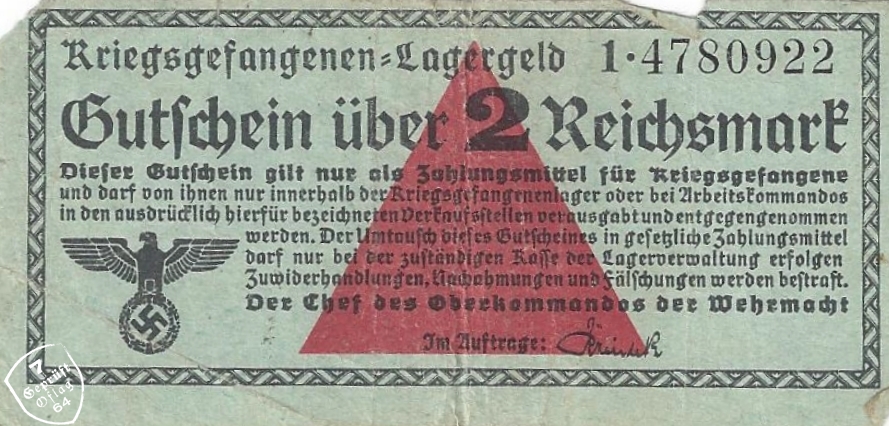
“Our first meal at Rotenberg was fairly good. We had a thin soup, several potatoes, and two or three slices of a kind of sausage. Some of it was blood sausage, which I never learned to eat no matter how hungry I was. (…) Many of the officers shaved for the first time at Oflag IX A/Z. (…).We were able to stay really clean at Rotenberg for the first time. There were fine tiled showers in the basement and it was possible to take a cold shower every day. Warm showers were provided once each week and it were run on a tight schedule which gave each man about six to ten minutes in the shower room. (…) We received our first pay at Oflag IX A/Z. (…). The money we received was not the regular German mark, but a prison camp paper money good only in the camp. This was printed on flimsy paper in a variety of colors, designating different amounts. It was pretty but useless.”


Original Prisoner of War Camp Money from 2nd Lt Seymour R. Bolten'sWWII belongings archive; brought to Szubin by Susanna Bolten Connaughton a year ago, so we had a chance to scan it.

The annotation on Prisoner of War Camp Money as translated in the book by Howard Randolph Holder:
 
“Prisoner of War Camp Money
Scrip good for 1 [2, 5, 10, 50] Reichmark
This scrip is valid as a legal tender for prisoners of war only, and may be spent by them or accepted only in the specially designated stores inside the prisoner of war camp or at the work camps.
The exchange of this scrip into legal tender can be made only at the authorized cashier’s office of the camp administration. Violation, imitation or counterfeiting will be punished.
The Chief of the German  High Command.
By order: [Signature]”

Very soon the American officers become involved in a variety of camp activities. As can be read in Lu Wilcox’s [Capt. Lumund Wilcox] memories:  
“They [British officers in Oflag IXA/Z] were extremely cordial to us and naturally they wanted to know everything that we knew about war and about England, but until they fully investigated each one of us, and interrogated us about the others, they did not tell us anything about themselves or about how they were living in prison life. After they were satisfied that there were no German sympathizers in the groups, they opened up and gave us our first lesson on how to be a prisoner of war and survive. (…) [British officers in Oflag IXA/Z] taught us how to be most comfortable living in a jail. (...). The third category I would place under fun and games. The prisoner of war has nothing but time on his hands. He can sit and worry about himself or he can engage in worthwhile endeavors for his own betterment, or he has lots of ingenuity, he can think of a thousand ways to bedevil his captors to a point of frustration, but never to go beyond.”

Excerpt from memories of 1st Lt. O. L. “Brad” Bradford:
“They [British officers in Oflag IXA/Z] staged entertainment every week or so. Goddard [1st Lt. Kenneth H. Goddard*] and Rankin [2nd Lt Robert Rankin*] on drums and trumpet quickly had a fair swing band going with borrowed instruments. They produced an All-American Revue, mostly folk songs and radio humor which was very well received.” 
*Both prisoners of war in Oflag 64.

Some of the American Officers were also involved in theatrical productions made by British Officers. Major G. C. “Geoff” Steel, the Englishman, was producing a play which called for three American parts. According to the “Escape To Russia” book, he learned that Howard Holder (the author of the book) was interested in dramatics, so he invited him to rehearsal. The other recruited men were 2nd Lt. John L. Cramer, Jr. from North Braddock, Pennsylvania and Capt. Wilfred “Bill” F. Farrell from Wilmington, Delaware, both also later held in Oflag 64.

“The play was an English farce, filled with slapstick comedy (…) This play was well received, and we had a lot of fun putting it on. We Americans later produced a hurried variety show with less than two weeks for writing and rehearsal which was based on the Hellzapoppin’ theme, ending with a sentimental ditty sung to the tune of “Tea for Two” and dedicated to our friends the British. Thanking them for all they have done for us.”

Here are two scenes from “Grouse in June” taken from the“Escape To Russia” book by Howard Holder, with the original caption: Bill Farrell is the tall man in the checked shirt; [John L] Slick Cramer is the man in the suit, holding the gun, and I am the man in the sweater. (The ‘women’ are, of course, other POWs).

Two scenes from “Grouse in June” taken from the“Escape To Russia” book by Howard Holder.

The original photographs below were shared by David Glendinning, son of John A. Glendinning. According to writing on the back, these photos show two other scenes from the same production presented at Oflag IX A/Z in April 1943. The other portrait photos present the cast of the play in full stage make up, and the writing on the back also identified the American POWs who were involved.

Two other scenes from “Grouse in June”, Oflag IX AZ, April 1943. Writing on the back say: “Act One”.

Howard R. Holder

Bill Farrell

John L. Cramer


Three unidentified, probably, British POWs, who took women's parts in stage make up.

***

More about prison camps for Allied officers at Spangenberg and Rotenburg an der Fulda, Germany
can be learned from Peter Green’s blog Oflag IX A/H and Oflag IX A/Z. Peter Green is the author of the book “The March East 1945 - The Final Days of Oflag IX A/H and IX A/Z”.

References:

  • "Escape to Russia" by Howard Randolph Holder, 1994; thanks to David Durgin for the photocopy of the book.
  • Transcript of War Log of 2nd Lt. John H. Glendinning available in “Sketches of lives of Kriegies in Oflag 64” (Thanks to Cynthia Burgess).
  • Memories of 1st Lt. O. L. “Brad” Bradford: "The Way It Was" available at www.oflag64.us.www.oflag64.us
  • Special thanks to Susanna Bolten Connaughton for sharing the original Prisoner of War Camp Money from her father's archive.
  • Special thanks to David Glendinning, son of John A. Glendinning, for sharing the previously unpublished photographs from his father’s archive, originally taken in Oflag IX AZ.

© Mariusz Winiecki